By Maxime Lu / 陆江
Published on DecanterChina.COM, Chinese version of Decanter.
2 March 2016
In recent years, online retailers and their highly efficient delivery systems have largely changed people’s shopping habits in China. Such changes made online shopping one of the most important and fast-growing channels for Chinese consumers to purchase wine.
Read our exclusive interview with ZHAO Dabin, head of the wine department of Chinese online retail giant JD.com, to learn about the scale and current state of its rapidly growing wine business.
 Image: ZHAO Dabin (right on the front) and LIU Qiangdong of JD.com signing agreement with Treasury Wine Estates
The scale of the business
As one of the biggest online retailers in China, JD.com launched its wine business at the end of 2010, ZHAO Dabin, head of JD.com’s wine department, told DecanterChina.com.
Wines sold on the site come from two sources, Zhao explained; JD.com works as an importer to buy wines from abroad and sell it directly, but it also serves as a ‘shopping mall’ for wine merchants to host their own shops.
The wine sales from both channels now account for a quarter of the retailer’s total annual sales of alcoholic beverages, which is expected to fetch CNY10.5bn (GBP1.1bn) in 2016.
‘Chinese white spirit (Baijiu),’ said Zhao, ‘still occupies the vast majority of the sales.’
In 2015, JD.com imported and sold CNY400m’s worth of wines itself, and the number is expected to triple in 2016. The sales through the merchants, on the other hand, are expected to hit CNY1.5bn, three times the amount of 2015, according to the retailer.
These estimates may still be ‘too conservative’, said Zhao, as JD.com has already sold 100m RMB’s worth of wine on its own from the start of 2016 to 20th January. ‘For January only, we have achieved four times the sales of last year.
Direct import vs merchants
Though JD’s direct wine import and sales business is growing rapidly, Zhao doesn’t believe that it would pose significant threat to merchants who sell their wines through JD.com.
‘Not all the wines are suitable to be sold by JD.com,’ explained Zhao.
For brands that are dealt by JD.com directly ‘they need to share a fixed amount of gross profit with us’, and their sales figures need to ‘keep up the pace’ of the fast-growing online retailer. JD.com would evaluate the performance of its own brands, and ‘eliminate’ the underperformers.
In fact, currently wine merchants take up a bigger chunk of the wine sales on JD.com, said Zhao. More and more merchants come organically or are invited by JD.com to build their own online stores. ‘The number of merchants defines the growths of the sales.’
The vast consumer base also suggests the size of the market. At the moment, wine consumers on JD.com are mainly office workers from Beijing, Shanghai and Guangdong, said Zhao. In late 2016, the retailer plans to reach out to villages and third and fourth tier cities.
‘Most of our wine consumers are still at entry level, though there are so many wine brands out there,’ said Zhao, pointing out that ‘only 3% to 4%’ among JD.com’s vast number of registered users buy wines at the moment. ‘There’re still plenty of room to grow.’
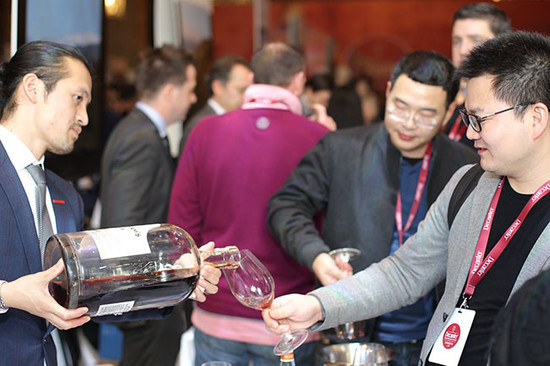
Image: Chinese consumers at 2015 Decanter Shanghai Fine Wine Encounter
Domestic wines vs Imported wines
In 2015, China has imported significantly more bottled wines compared to 2014. The Free Trade Agreement signed between China and Australia is believed to pose more challenges to China’s domestic wine producers in the next few years.
Currently domestic wines account for 30% of JD.com’s self-run wine business, whereas imported wines take up 70%. Zhao believes that other major online retailers, such as Tmall.com and Yhd.com, rely ‘even less’ on domestic wines.
Among the merchants on JD.com, 15% of the brands they sell are domestic, although the sales volume of domestic wines is ‘slightly more’ than that of imported wines, said Zhao.
Though the growths of imported wines are constantly put under the spotlight, in the third or even fourth tier cities in China, domestic wines still dominate the market. ‘Imported wines still can’t break into the smaller cities,’ said Zhao, ‘although in the first and second tier cities, the sales of imported wines are almost equal to that of domestic wines.’
Facing such challenge, domestic producers are seeking to expand their business.
The two biggest wine producers in China, Changyu and Great Wall, ‘are still among the top three best-selling brands on JD.com,’ said Zhao, adding that the two brands alone take up over 90% of the sales of domestic wines on the platform.
 Image: Chinese wine lovers at 2015 Decanter Shanghai Fine Wine Encounter
The most popular price ranges
The top countries for imported wines on JD.com are led by France and followed by Australia, Chile, Spain, Italy and America. The most popular price ranges on the online retailer, according to Zhao, are ‘under 50RMB’ and ‘50-100RMB’.
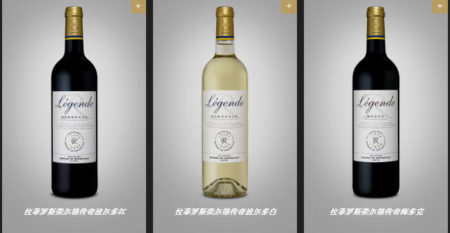
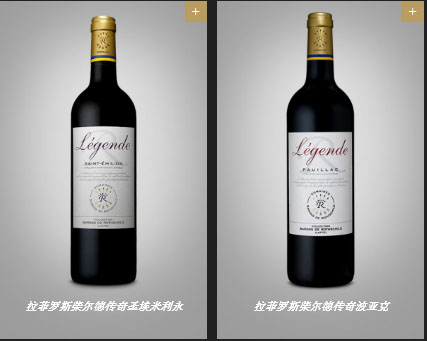
The ‘under 50RMB’ tier is dominated by Spanish table wines. Among wines priced 50-100RMB, consumers can find entry-level wines from the Domaines Baron de Rothschild (Lafite) and branded wines such as those from Penfolds Rawson’s Retreat, Yellow Tail and Casillero del Diablo of Concha y Toro.
The range of ‘100-200RMB’, however, showed the most significant growth among JD.com’s self-run brands, said Zhao.
‘We work as an importer and retailer at the same time, so we won’t add too high margins. This is a very popular price range in the general market as well.’
JD.com is also keen to develop its fine wine portfolio, namely those priced at 200 to 500 RMB. The sales during 2015 and the Spring Festival period in 2016 showed the potential of these wines.
‘None of the online retailers would satisfy on selling only the entry-level wines. We need to go upstream.’
The effect of the austerity policy
‘The austerity policies have brought no negative effect to JD.com what-so-ever; if anything, it was beneficial to us,’ said Zhao.
‘The anti-corruption drive mainly tackled the mid-to-higher range products. JD.com, on the contrary, is a retailer targeting the mass consumers.’
The bubbles of the mid-to-higher range have now burst, bringing the price back to the reasonable range. ‘More and more people were looking for value-for-money wines, which was great news for us,’ said Zhao. ‘While overall the industry struggled to grow, we managed to triple our wine sales from 2014 to 2015.’
Choosing the right supplier
Now five years in the wine business, JD.com believe its biggest challenge comes from the supply chain.
The suppliers can’t necessarily foresee the scale of the sales, thus may struggle to prepare enough stock for the fast-growing retailer, said Zhao.
Facing such challenges, in 2016 JD.com intend to re-evaluate its 1300 wine products by regions, and to focus its resources on fewer but better brands and suppliers. However, the adjustment should not interfere with the growth, Zhao said, ‘we should be able to keep growing at the rate of 300% to 400% (per year).’
About 2016
Speaking about China’s wine market in 2016, ‘I don’t expect an explosive growth,’ said Zhao.‘We still don’t have enough wine consumers in China, which is why we need to encourage more consumers to start drinking wine. Meanwhile, we need to further control the distribution costs, and provide down-to-earth prices to consumers.’Coming next month:JD.com: Controlling the authenticity and quality of wine products
Translated by Sylvia Wu / 吴嘉溦
Source: https://www.decanterchina.com/en/knowledge/people/importers/jd-com-mapping-the-landscape-of-online-wine-sales-in-china-part-i
All rights reserved by Time Inc. (UK) Ltd. No part of this publication may be reproduced, distributed or transmitted in any form or by any means without the prior written permission of Decanter. Only Official Media Partners (see ‘About Us’ page on the website) of DecanterChina.com may republish part of the content from the site without prior permission under strict Terms & Conditions. Contact china@decanter.com to learn about how to become an Official Media Partner of DecanterChina.com.